
Core Working Group workshop: “EU Decarbonisation in the global economy"
The workshop explored EU Decarbonisation in the Global Economy, focusing on how the EU’s trade and climate finance decisions influence its decarbonisation efforts and global impact. The workshop outcomes will shape how we use the project’s Integrated Assessment Models (IAMs) to provide policy-relevant insights, and brought together policymakers, civil society, and industry representatives to collaborate on policy-driven modelling.
During this workshop, we sought valuable insights on our research agenda, realistic scenario design, and potential applications of our analysis. By engaging with senior energy and climate policymakers, we have identified key research questions for assessing the impact of EU decarbonisation in the global economy. Expert contributions will directly influence our research.
The workshop discussed two related modelling studies:
- How do global trade dynamics and policy frameworks impact the EU’s decarbonisation efforts and green technology transition and cooperation, in a scenario of increased trade and economic tensions? This study is led by Imperial.
- Enabling governance structures for (international) climate finance This study is led by NTUA.
At the start of the workshop, a brief introduction of IAM COMPACT as well as the aims of the workshop were discussed by Bruegel. Then, study leads briefly presented the background and approach of both studies, before splitting into two break-out rooms.
Room 1: Trade
Topics for discussion:
- What are the expected short- and long-term impacts of restricted trade with China and the USA on the EU’s decarbonisation efforts? Which indicators are of most interest to illustrate them?
- What countries are best suited to partnering with the EU on green technology? - In other words, who else is suitable for supplying key green technologies? - Latin American countries, India, and Indonesia? - Are countries that are closer geographically more suitable partners?
- What are the most critical uncertainties in these scenarios that should be addressed in the results' discussion? How could this inform policymaking?
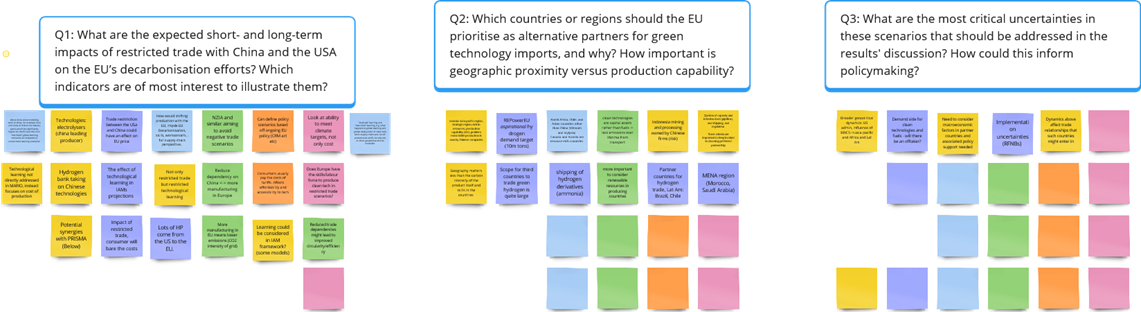
Key takeaways:
- Impact of restricted trade: consumer will bare the costs
- More manufacturing in EU means lower emissions (CO2 intensity of grid)
- Consumers usually pay the costs of tariffs. Affects affordability and accessibility to tech
- Reduced trade dependencies might lead to improved circularity/efficiency
- Geography matters less than the carbon intensity of the product itself and skills in the countries
- More important to consider renewable resources in producing countries
- Need to consider macroeconomic factors in partner countries and associated policy support needed
- Include technological learning in IAMs
Room 2: Climate Finance
Topics for discussion:
- How could the NCQG ensure alignment with the priorities and needs of vulnerable and developing countries (including in adaptation financing)?
- How should the climate finance system change, in order to align it with the investments and actions necessary to deliver the goals of the Paris Agreement?
- What concrete policy instruments could prove key to address fiscal challenges in developing nations and help provide the necessary surge in climate finance flows onwards?
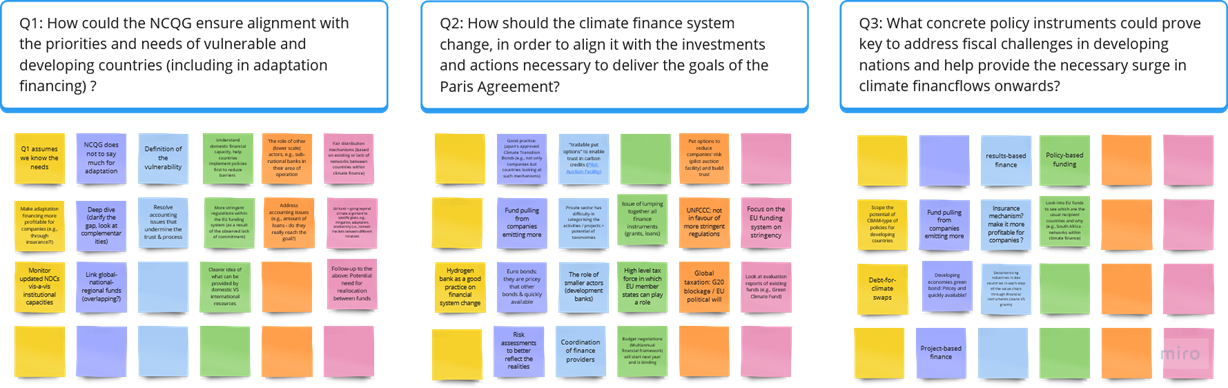
On NCQG:
- Stakeholders noted that Q1 already assumes that priorities and needs of vulnerable and developing countries are known and defined, when in fact they are usually assumed. A commonly accepted definition of vulnerability could help.
- One key aspect of NCQG could focus on resolving accounting issues of what is considered “climate finance”, and deep dive on the climate finance gap and the domestic financial capacity of recipient countries with the aim to explore what can be provided domestically and what should be provided from international sources.
- A link among national, regional, and global funds was proposed, to tackle overlapping. Explore potential need for reallocation between funds.
- Good starting point: Climate Policy Initiative (top-down & bottom-up needs, climate finance flows sources & allocation)
- The types of climate finance available vary from grants and concessional loans, to guarantees and private equity. The architecture has differing structures of governance, modalities and objectives. While the transparency of climate finance programmed through multilateral initiatives is increasing, detailed information on bilateral initiatives, regional and national funds is often less readily available, and fair distribution mechanisms are needed based on existing networks among countries.
- On the role of EU, more stringent regulations within the EU funding framework were also proposed, given the lack of observed commitment. An EU fund could go beyond making
On financial system changes:
- Good starting point for the study: evaluation reports of existing funds (e.g., Green Climate Fund)
- Japan’s Climate Transition Bonds were proposed as a good practise. Not only companies but also countries can explore such mechanisms.
- Tradable options may enable trust in carbon credits (see Pilot Auction Facility)
- The potential of taxonomies could also be explored could help private sector categorise activities/ projects.
- They also identified issues of lumping together different sources of finance that are not equally efficient, which must be resolved. The role of smaller actors (development banks) should also be enhanced, as well as the coordination among finance providers.
- The European Hydrogen bank was proposed as a good practice on financial system change.
- Stakeholders agreed that a potential global taxation scheme will be blocked by G20. For the EU, budget negotiations on the next EU's Multiannual Financial Framework (MFF) are expected to start in the second semester of 2025, and are binding.
On policy instruments:
- Results-based finance
- Experts proposed fund pulling from companies emitting more.
- Scoping the potential of a CBAM-type of policies for developing countries
- Debt-for-climate swaps
- Decarbonising industries in dev countries in each step of the value chain through financial instruments
- Look into EU funds to see which the usual recipient countries are, and flesh out networks of climate finance.